
Dec 19, 2016
Home Between Crossings Released in December, 2016
https://www.createspace.com/53
https://www.amazon.ca/Home-Bet


Sep 20, 2015
Bead Bai: Excerpt from the Chapter on the Great Migration
The
elders’ shifting eyes expressed doubts such as those that come from the fright
of loss of direction of one gone astray in a jungle. Then someone asked a
different question that made the panchayat assembly think again, “Why is it that
every caste around Haripur is going to Africa but the African Siddis are not?”
More doubts were now expressed in questions about the Siddis, “Why are the
Siddis staying behind? What will they eat? Where will they get the water from?”
These questions silenced all for a while before they began asking again, “Do
they know something we don’t? Do they eat people in Africa? Will the English
enslave us to work in mines and on plantations?” The elders shook their heads
from side to side dole dole in agreement, “Yes there must be a reason why they
are not leaving.” Finally the panchayat council sent Mota Bhai to enquire from
the Siddis why they do not leave Saurashtra for Africa yet they have no food in
their granaries.
When
Mota Bhai returned, his hands were trembling; his voice shook when he told the
panchayat what the Siddis said to him. “Our forefathers worked this land and
fought for dignity. Here they served, ruled, cleared the jungle and built forts
so we may live with pride,” they said. “Our ancestors protect us now. If we
leave, who will bring the unshaven coconuts and incense smoke to their altars?
Who will dance the goma? Whom shall we consult when our children are born and
their destinies made? Whom shall we
consult at marriages? Whom shall we consult at funerals? Yes, we are hungry,
yes there is no food in our granaries but our ancestors reside here. This land
is ours and we are free.”
The
Siddis then put questions to Mota Bhai that he said, he not only had no replies
to but had never before even thought about. They asked: How could the
panchayats of Saurashtra, who had never been enslaved or dispossessed of their
country, know what was in the hearts of the Siddis? How could they understand
the African custom that reveres the land where the ancestors are buried not
cremated? Did the Indians have slave memories like those of the Siddis? Did
their ancestors walk in coffles under the blazing sun? Ancestors,
exhausted-beaten-starved sleeping in coffles? Ancestors, in coffles made to
copulate to replenish the slave stock for their masters? Then a Siddi elder who
was so thin and weak that he could not stand without shaking even when holding
a stick, asked, "How could they? Their heads are full of what the English did to
the Indians, not what the Indians did to the Africans?"
----------------------------------------
http://khojawiki.org/Gujarat_Famines_%26_Khoja_Migrations and then also from here click on an article by Mike Davis and Jambudeep's Blog
BBC Documentary on Indian Migrations during the Famine Years
BBC https://www.youtube.com/watch?v=oxl4q_jfDPI

Siddhis
For more on the Siddhis of the Indian sub-continent click below. View some amazing historical photographs and paintings of the Siddhis
http://exhibitions.nypl.org/africansindianocean/essay-south-asia.php
For the present day photos of Siddhis see:
http://www.bbc.co.uk/news/world-asia-india-22637058
Siddhis the fast disappearing Indians of African origin:
http://qz.com/440978/meet-the-fast-disappearing-community-of-indians-and-pakistanis-of-african-origin/
Bead Bai: Chap-panyo dukar, Saurashtra 1896 -1902
Losing the land and Saga of the First Crossing

Indian Famine. Photo from Late Victorian Holocausts by Mike Davis (see note below)
Extracts from Chapter 9 Losing the Land
When the drought of Chap-panyo prolonged, the earth turned hot everywhere, as far as you can see, so hot that it hardened into a rock and then it cracked in sharp edged pieces like a broken clay water pot.

My father’s last two cows died of thirst. Peanut plants turned brittle, nuts shrivelled and withered before the locusts came. Pests – I see black locust clouds over my head. Ma! Ma! She does not hear me. And then more pests - white grub infestation spreading like an epidemic scarab at the roots. Working all together, my father and me, all my brothers and sisters, working hard, we try to salvage the frugal crop and put it into sacks. But the colonial agents carry away the gunny sacks of our dwindled harvest in payment of taxes my father cannot pay in rupees. We are forced to sell our wooden plough and tools to buy food, and even water.
Those
young men who had left during the previous drought arrived with the desiccated
Monsoons. Some came to collect their families, some to get married, and some to
pay back loans that helped them to reach Africa.
Now before they return they would recover their family jewellery from the
village pawn broker and carry it with them. They said sweet water, milk and
honey flowed in Africa like rivers from the Himalayas,
and that one could eat one good meal a day.
At the women’s satsang meetings, they discussed the famine and the great
emigration of families out of Kutch and Gujarat.
Elders sat in separate panchayat councils according to their castes. They sat around their own chosen village
peepal tree the whole day long discussing what they heard and what wisdom they
knew from the teachings in the scriptures and what the astrologers told them.
My grandfather, once the mukhi of Haripur, reminded the Khoja panchayat council
once again, how much Saheb desired for us to leave Kutch and Gujarat for Africa. No sooner had he spoken than a multitude of
questions assail him like bullets from a barrel, “How can we abandon the land
of our ancestors? How can we break the bond with the earth that is sacred? Here
the pirs sought ginan in the song of the gurus of Hindustan
under the peepal tree and hill temples. Who will tend the fields when the rains
come? Who will clean the wells? How can we cross Kala Pani that protects our
motherland?” Some put their fears into questions. Others show their reluctance
to abandon their fields also through their questions. And there were those who
hoped the famine will pass. After all famines have always come and gone but
their forefathers never deserted the land.


Mike Davis, Late Victorian Holocausts 2001, page 163.
How
could the elders’ of the Khoja panchayat have imagined an exodus of this scale
when there was no mention of losing the land in oral histories so carefully
handed down by the learned keepers of stories, genealogies and songs of
Saurashtra? Even the Ramayana and Mahabharata did not predict a migration such
as the one we were witnessing. Even the sages who cautioned about Kal Yoog, the
Age of Blackness, that many believed was close at hand, were lost for words. It
is true that the astrologers, reading the changing web of stars, warned about
the coming calamities, something that was destined to happen in the age of Kal
Yoog. But did they know about losing the land?
That
evening my mother removes her siri – a small cent-size diamond studded nose
button, and her two silver anklets, the last three pieces of adornment on her
that was our farm’s security should the tax collectors seize the land because
of unpaid head and land taxes as they did to Nagji Bhai’s and then Kanji Bhai’s
farms. Both our neighbours.
"Take
these, son,” she says to me, "they will pay your passage to Africa."
“And
with this son, buy your paper,” says my father handing me some loose silver
King Emperor coins and Kutch koris in a cloth
pouch. He cries more than my mother does. He is letting his first born son go.
The one destined to care for the family field, to care for him in old age, to
keep the forefather’s name honouring the lineage. That’s how it had always been.
That’s how our family history was told as father to son inheritance of one
hundred peanut plants. He cries because he has no money to see me married so I
could have at least left my seed behind as Mukhi Nanji Bhai’s and Jeraj Samji
Bhai’s sons had done to continue their lineages before they went to Africa. That was custom. Then it would not have been so
hurting to my father. He would have played horse with my son riding on his
back. Carried him to the field on his shoulders like how he carried me when I
was little. That would have assuaged the pain of his loneliness that stuns aged
parents when their children as migrants leave and do not return when adults.
Such was the loss of a son for my father.
When
the time comes to leave, I hold my parents’ feet as I make a promise that I am
going to Africa to look for work, and will
return with riches. I weep as I take the earth at the base of the family neem
tree where my ancestors had toiled with their bare hands, and earned a living
that sustained both the lineage and honour. We worked the land, generation
after generation, and seeded it; we harvested, and offered prayers of santosh
invoking names of ten avatars over the harvest. Our offering was wheat and
milk, a portion of the fruit of the labour of the farmer’s toil, a prayer on a
clay plate for the peace of our forefathers, as they had offered the fruit of
labour of their toil at the same village jamat khana. As peasant farmers do at
shrines in India.
We, who work the land with our hands, revere customs that keep us close to the
land. This was bequeathed to us to uphold. The Earth is the keeper of our faith
and customs. “We have never begged a morsel from the jamat,” my father tells
me. “You too will uphold the family honour. That is our custom and trust in
Saheb the Sarkar.” I hold the earth in
my fisted hand, and press it to my left and right eye, and then between the
eyes on the forehead asking the land permission to leave, asking its
forgiveness for leaving, and then its blessings on the unknown journey over the
Black Waters. In that gesture, I pay my
homage to the land and say shukhar to creation the sacred with my head below my
heart like the village Sufi. I make a
silent oath to our ancestral field that I will return to restore its health,
beauty and prosperity as it was before the drought wrenched it all out of her
like how the butcher drains out the blood of the slaughtered animal. My
parents, sister and brothers weep when they see me, the eldest male child, the
provider of bread, keeper of family stories and honour, their elder brother and
their mentor, climbing onto Karsan Bhai’s bullock cart. My thirteen-year-old
sister who was given away in marriage to a widower, a textile merchant three
times her age, because of our poverty, arrives to bid me farewell just when the
wooden wheels creak to turn. We called her Dholki for she talked too much like
a drum. We weep because we know in our hearts that I am losing the land, I am
breaking the bond of lineage nurtured by the ancestral field. In all these, I
am losing the family – my parents and all my brothers and sisters. My heart
cries for it knows I am overlooking the promise of my birth not because I want
to but because I have to.
Karsan
Bhai cracks the whip and yells to the bulls to move. My family hold on to the
cart while they walk with it to the stone that marks the end of our field. I
feel something in me break as I leave the ground where my relations are buried
and where I would have been buried at the roots of the neem tree. My mother’s
wails sear the honeyed quietness of the coming dawn. I feel weak at this hour of peace when the
jamat in my village wakes to meditate and greet the new day. I press my ears in
my palms to keep away the metrical turns of the wooden wheels, creaking
melancholically out of Haripur. I sob and bury my face into the bundle of
clothes my mother had packed so neatly in a clean bed sheet that releases a
fresh smell to the warmth of my tears. "Do not weep, son," says Karsan Bhai.
I knew
Karsan Bhai almost as well as I knew my own father and he always called me
‘beta, son’. My friends used to joke about how Karsan Bhai ate with his
whiskers that stretched over his cheeks from ear to ear. "Where are his lips?"
we used to ask each other because no one had ever seen his lips. He looks at my
saddened face and his eyes well. He speaks to comfort me, “With heavy heart, I
have taken boys like you to the railway station at dawn. All boys who leave for
Africa know they will not see their mother
again; she too knows she will not see her son again. I tell them to open their
eyes when they feel the pain and fill them with this land of their ancestors
not with tears, and keep her there. The land is mother too.” The cart trundles
around the curves; the oxen lumber along the stony roads, snorting to the cold
in the breeze pushing the darkness away like smoke. Karsan Bhai clicks his
tongue, bellows out ‘Chalo rey chalo!’ and cracks his whip to the oxen’s ears
over their gaily painted horns. "All emigrants leave their mothers behind,
shanti, shanti, shanti." He mumbles to the breeze to take his pain away with
the night so he must do what he has come to do. “O my Mowla, why have you given
me this charge of severing umbilical codes?” he says and immediately begins the
prayer for peace, “Pirshah, pirshah, pirshah.”
“Kemcho Sunderji Bhai?” Karsan Bhai yells out
a greeting over his shoulder at a figure on the other side of the river. The
man is wearing white Gujarati peasant clothes and turban standing alone in the
cold haze that sits on the river before the break of dawn. The man yells back
through the mist stretching out his arms but we cannot hear him over Una’s rocks
and dry hollows. I hesitate to bid him farewell. He yells again with a gesture
indicating he wants to embrace me goodbye. Turning around, Karsan Bhai
questions me with a puzzled look on his face. I stand up throwing my arms
forward indicating I want to embrace him goodbye too. Then I see him squat on
his haunches thumping his palms on his forehead the way Gujarati men cry the
pain in their heart. I begin to sob again.
This
was my land of the Satpanth Khoja, villagers of a common founding father, the
Satguru Noor, the true guru and pir, the Light and Vishnu avatar above
all. We made a faith knot of villages
across Saurashtra, sang the song of creation, how life evolved from the fish to
the amphibian turtle, animals and then came the human avatars who fought evil
for sovereignty of the good for ever. We danced Krishna’s
courtship dance, the garba, like it were a karmic circle - dha dhi na, dha tu na, and offered devotion in food, incense and flowers
with shukhar on our lips. Once a year, neighbouring villages partook in a
communal meal prepared by women with veneration in their hearts and love in
their hands, to serve the community and Saheb. Feeding the community called the
jamat, is sewa and sharing a meal brings baraka of blessings to all givers and
receivers of roji the morsel for sustenance of life. Here is where I played
gulidanda, jumped the river stones and bruised my knees.
Now I must leave my ancestral land for Africa.
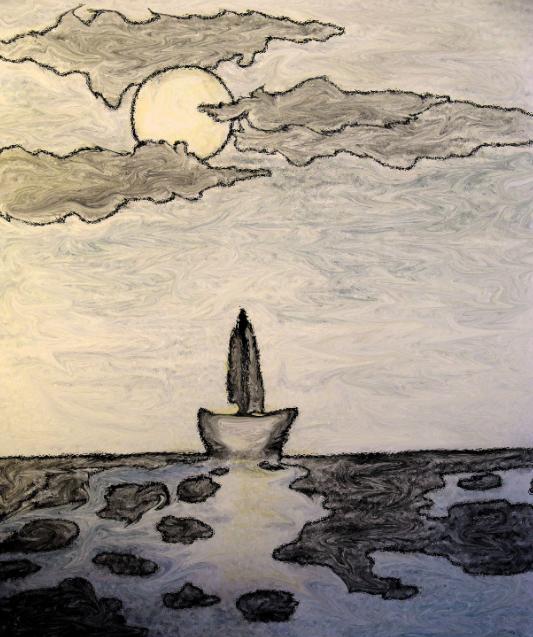
Illustration by Sadiq
To read more on the Great Famine of India see Late Victorian Holocausts by Mike Davis, Verso, London 2001. Inferno in Gujarat Pages 170 - 175.
Author Mike Davis


Click: For images of late 19th - early 20th Century Colonial Era Famines in India
Mike Davis gives estimated mortality figures for the 1896 – 1902 Famine in India quoting from three sources:
The Lancet, 16th May 1901 19.0 million
Arap Maharatna, The Demography of Famine, Delhi 1996/
Roland Seavoy, Famine in Peasant Societies, New York 1986 8.4 million
Cambridge Economic History of India, Cambridge 1983 6.1 million
(Late Victorian Holocausts, 2001 page 7)
Note: Since this famine was in 1956 of the the Vikram Samvat calender, it is known as Chhappania Akal or Chhappania Kal or the famine of 56. http://www.gktoday.in/chhappania-akal-1899-1900/ It's called Chap-panyo Dukar in Gujarati.
Incidentally the dates coincide with building of the Great African Railway called The Uganda Railway. Thousands of coolies were imported from famine ravaged India. The death rate among the railroad workers was 4 per mile while 16 became permanently disabled and had to be shipped back to India, and replaced with new recruits. Many became demented and were imprisoned in the dungeons of Fort Jesus together with the runaways. The suicide rate among the imprisoned coolies may have been up to 80% (Kapila, N, Race Rail and Society: Roots of Modern Kenya, Nairobi 2009).
Aug 18, 2015
Bead Bai: Swastika in Khoja Feminine Memory

Seals from archaeological excavations at Harappa and Mohenjo-Daro
Acknowledgment: The British Museum Collection http://www.britishmuseum.org/explore/highlights/highlight_objects/asia/s/indus_seal.aspx
The earliest su-astik, the symbol for Blessings of Abundance, is found in seals from archaeological excavations at Harappa and Mohenjo-Daro (approximate region of Sindh). These were the pre-Hindu and pre-Islamic civilizations of the Indus Valley between 2600 to 1900 BC. The symbol has been preserved for thousands of years by many cultures of India, China and Japan, over many geographies, religions and ideologies. The su-astik has been handed down from a woman to woman in Khoja families and lives as a living tradition in the Khoja women's visual memory. It is re-created in the sapatia configuration in one of the elaborate ritual arts of the Khoja marriage. The su-astik reminds the bride and groom of their origins as they are blessed stepping over the threshold to make a family of their own and a new generation. Making of the swastika in rice grains is also called saathia puro.
Extract from Bead Bai (2nd Ed 2014)
Part Eight Chapter 31 pages 264 -269
Su-astik at the Threshold
I step into the Devji family home, a sixteen year old bride in a pink velvet frock on which flows zari vine at the side from the ankle to the shoulder. People of the town come to see me, the wife of their own Nairowua born boy with smallpox marks on his face. Haiderali was born of Khoja Momna bead merchant family on the border of Kenya Colony and Tanganyika…
“She is the wife of my first born son,” proudly says Ma Jena Bai to the women of her jamat khana volunteer group called the Naandi Committee. The Naandi Committee receives, sorts out and arranges the evening’s food offerings at the veranda where the evening draught pushes the fragrance of the cooked curries and smoke of loban over red hot coal into the open courtyard. “She is a blessed Saurashtran devi,” someone at the back whispers. Yes, I am beautiful like the ancient women of Ajanta, fairer than all the men and women of the Devji family. I am of narrow waist on broad rounded hips and a backside bulge under my long velvet frock…
I stand on the patlo stool like a statue on a pedestal at the threshold of the Devji home, listening to my sass, Ma Jena Bai, bragging how she found me. However, she knows my Dadabapa gave me to Devji Momna, her husband’s father, to seal their friendship with a tie of their grandchildren’s marriage, forever. She talks about my accomplishments as a zari embroiderer and teacher’s assistant at the religion school. “She is shy,” I hear someone say. In truth, I felt lonely. Uneasy among the people I had never seen before. I was not shy. I keep my eyes down, screened by my pachedi pulled over my forehead in laaj, avoiding any eye contact. Eyes that are studying details of my symmetry. I feel like a prey, circled by a pride of lions whose hungry yellow eyes are fixed on the impending kill and feast. I tense my body, push my shoulders in and hold myself together standing on the patlo stool. In my hands is a coconut, the seed of life awaiting fertility to birth. Meethi Bai told me I would be bringing new life into the Devji family home to continue their progeny, honour and name. Haiderali stands by my side on another patlo stool. He is laughing and joking with the women who in turn laugh at him in fake mockery, lisping audible whispers, “You are such an ugly toad. You are black. You are short like an eggplant. Your nose is a trumpet. Your hair a mesh of wire. You don’t deserve this bride! This jewel of Nairobi!” Cold sweat trickles down my nape under the pachedi…
“Jari, come and sit here beside me,” Ma calls Zarina her daughter. “The rice is for fertility,” says Ma Jena Bai to Zarina, instructively, as she goes over the su-astik with a second line of rice trickling from her funnelled fingers. She performs the ritual of describing the su-astik before us speaking in resolute sentences. “It’s the su-astik that connects the ancient religions of Saurashtra - Jainism, Buddhism, Satpanth and the many panths descending from the Vedas that hold pirs’ words sacred. Here in the centre where the four lines meet, we place a piece of silver, the mark of Laxmi and Light of Satgurpir. Put it here in the centre of the su-astik,” says Ma putting her finger on the point at the union of the four sides of the su-astik. “The union is propitious. It’s the meeting of the four directions. Marriage is such a union.” She gives Zarina a fifty cents silver coin with the head of bearded King George, crowned and cloaked in fur. “Now take this betel nut and stand it on the fifty cents sumuni. The hard seed protects the shine of prosperity in the house. Keeps evil away.” I know the su-astik is the chakra’s centre of life’s energy from all directions and a welcoming sign to the lucky bride, the incarnate Lakhsmi who brings abundance as she steps over the threshold into her new life.
I step over the threshold with my right foot and crash onto the inverted clay saucers revealing the su-astik sketched in rice. Suddenly the sound of crashing clay under my feet awakens me into a new life. Consummation of my marriage? I ask myself. I step over my childhood and enter into the Devji home, a woman. I have accepted the ancient sacrament of my forefathers and made a covenant with the Earth below my feet to take me home.
Aug 7, 2015
Bead Bai: Book Review by I Akthar, Prof of Khoja Studies, International University of Florida, http://khoja.fiu.edu/
Journal of the Indian Ocean Region Publication: http://www.tandfonline.com/loi/rior20 Published online: 05 Aug 2015.
http://dx.doi.org/10.1080/19480881.2015.1057430
Bead Bai, by Sultan Somjee, Charleston, CreateSpace Independent Publishing Platform, 2013, Second edition, vii + 457 pp., glossary, US$19.00 (paperback), ISBN 978-1475126327
This historical novel traces the life of its protagonist Sakina, a second-generation Asian woman of a merchant caste in early to mid-twentieth-century Kenya. The title of the book, Bead Bai, refers to Asian women of this era who worked as beadwork embroiderers known by the Gujarati honorific bā’ī, which may be prefixed or suffixed to names of women such as Sakina’s step-grandmother – Ma Gor Bai. The subtitle of the book is in Gujarati – khōṭā mōṭī nā sācā vēpārī – is the clever turn of phrase on the sign of Sakina’s family business that loosely translates as ‘honest merchants of false (i.e. imitation) beads’.
Sakina was born in Kenya and appears to be of Kāṭhiyāvādị̄ origin. She grows up with her stepmother, who migrates to Africa and later becomes a widow and is subject to the Indic cultural practice of shunning due to her bad fortune. Sakina is married off early to a Momna family and leaves Nairobi for Nairowua in Masailand, which straddles the southern border of Kenya and northern Tanzania. Marriage is difficult for her and here Somjee provides interesting cultural sayings that illuminate the intimate life of the characters, such as consolation given to her about her wedding night, ‘you will heal from the sore of a man when the red henna on your hands fades’ (p. 269). Sakina finds escape from the restrictions that her husband’s family imposes on her through communication with the Masai as a dukawala (‘storekeeper’) selling beads and other sundry supplies. Her learning of the organic spiritual patterns that compose the female Masai beaded collar, the irpusi or esosi, allows her creativity real expression. Recognising her power and position as an expectant mother, she has her stepmother brought from Nairobi to assist her in childbirth and shortly afterwards the novel ends with her return to her childhood home with the newborn son.
Somjee’s novel is based on nine years of research interviewing these women who were and are now in Western Europe and North America. The amount of material he was able to capture helps to recreate this world of Asians in Africa that has been neglected in the national narratives of postcolonial Sub-Saharan African states. The political instability and hostility towards Asians that reached its climax in the 1972 expulsion of Asians from East Africa dealt a deathblow to many of the scattered communities of Asian merchants throughout eastern, central, and southern Africa. From their initial settlements of the Zanzibar littoral, two hundred years of African settlement created a unique culture that was Indic in origin but African in expression. Unlike the ambiguity, conflict, and contestation between African and Asian identities that characterises M.G. Vassanji and Shajila Patel’s writings, Somjee’s protagonist finds her realisation of being and completeness by embracing African civilisation.
A sense of melancholy pervades Bead Bai for the loss of Khōjā culture that saw its fullest realisation in colonial Africa. Somjee refers to the communal world he creates as that of the ‘Satpanth Khoja’. This caste identity has almost been lost in 2015 period as the Khōjā define themselves along three Islamic creedal identities of Sunni, Ithnā ʿAsharī, and Ismaili. The South Asian origins of the Khōjā are unclear, but the communities that developed in the late nineteenth-century Africa developed mercantile networks from the littoral to the interior of the continent. They followed religious practices that were grounded in vernacular liminal devotion that later was discretely characterised as Hindu or Muslim. According to Somjee, the ‘Khoja Gita’ (p. 38) was an important text that was ritually recited invoking an Indic narrative of creation. Interacting with other Asian castes in Africa, such as the Lōhāṇā, qua a Khōjā identity allowed for a camaraderie that mirrored the long dhow voyage. While rhetorically concomitant, Khōjā identity prefigured the Ismaili identity of the community. Khōjā identity was dynamic and brought an ethnic pan-Asian solidarity to the fore in opposition to the Swahili, Omani, etc. As became the case with the western diaspora of the East African Khōjā, ones coreligionists can be different from caste brethren and herein lies the loss that is echoed by other contemporary African Khōjā authors, such as Hassan Jaffer. They are devout believers in their modern Islamic creed and yet feel great sadness for the loss of an ethnic Khōjā identity that has been subsumed within modern Near Eastern modelled forms of Islam, on which communal authority is based. They cite the loss of Gujarati and exogamy as examples of how the Anglophone Khōjā have forsaken their heritage. From this perspective, the Khōjā have become unbound from their ancestral lineage and duties of filial piety by embracing a secularist ethos of individualist consumerism. Jaffer presciently asks of the future in the subtitle of his latest book, Whither Khoja?
Bead Bai is an invaluable contribution to the foundation of what Emma Hunter describes as ‘intellectual history from below’ in African studies. There is a lacuna of research on how Indic religious cosmologies developed in the context of transnational migration throughout the western Indian Ocean. Indic religions were foundational in the shaping of social, political, and economic institutions that Asian communities developed in Africa. Much of Khōjā communal histories focuses on great traders, such as those of Alidina Virsam and Nasser Nurmohamed. The voice of women, the poor, and those in the periphery of the jamāt (‘community’) structure are rarely found. The fact that many of the original African Khōjā communities have disappeared and those that remain have an identity shaped more by Edmonton and London than Zanzibar. This means that these narratives will endure as an epitaph of the dynamism that Africa once provided for the development of the Khōjā. Khōjā Studies benefits greatly from such thoughtful and well-researched historical novels, such as Bead Bai and Allidina Visram. This form of historical fiction is a popularly accessible preservation of life experiences and perspectives on the past to be understood as a lens for examining the historical continuity of migration and dynamic identities that undergird the present. Communal historians, such as Somjee, are an important part of the subaltern writing of multivocal western Indian Ocean transnational histories. To wit, the more that participate in its thinking, discussion, and writing, the richer and more complex our understanding of this cosmopolitan period of Asian African history.
© 2015 I. Akhtar, iakhtar@fiu.edu
Khoja Studies http://khoja.fiu.edu/Florida International University,
May 20, 2015
Bead Bai: Gendered Identity at the Interstices of Art, Trade and Domesticity: A Socio-literary Analysis of Sultan Somjee’s Bead Bai
"Unlike in the case of migrations from the Indian subcontinent to South Africa and Mauritius, women arrived in East Africa mainly as 'adjunct' wives of male migrants. There are very few official documents to record their arrival, and the mention of personal details of these women and their fascinating experiences remain excluded from the footnotes of history. One therefore has to fall back on alternate sources to reconstruct the subaltern experiences of these women migrants, whose life-narratives have been subsumed within the larger collective history of their husbands or fathers. It is here that creative reconstructions can be used as an important tangential source to capture the finer nuances of gendered individual and collective mobility. This in turn allows for a deeper insight into processes of the formation of diasporic gendered subjectivities in the context of the East African Asian diaspora."
Prof Mala Pandurang
http://glocalcolloquies.com/wp-content/uploads/2015/05/Pandurang-Mala.pdf
Apr 14, 2015
Bead Bai: The Book Review Literary Trust volume xxxix no 3, March 2015. Mumbai
Gendered Experience
Bead Bai by Sultan
Somjee offers an engaging insight into the experiences of the Satpanth Ismaili
community in East Africa from late 19th century onwards. The early
entrepreneurs of this unique religious group developed a network of family
stores that spanned across the geography of East Africa. The petty traders set
off for the interior areas, spanning from the East Coast of Africa to the Congo
region, with foot caravans, carrying goods for barter such as blankets, cloth,
food stuff and building material. An ethnographer by profession, Sultan Somjee
particularly describes the community’s involvement in the trade of beads of
‘different colours, luster, sizes and shapes’ with ethnic tribes (p. iii).
Early 20th century, Satpanth women began to arrive on the East African shore as
child brides, and settled to their new lives in urban as well as rural areas.
Often, the merchant’s wife, mother and daughter would work at the family store
in the early days, handling the bead stocks, mainly imported from
Czechoslovakia. Somjee credits these women with enabling the flow of beads
between the traders and the ethnic tribes, particularly the pastoral Maasai. They
therefore came to be known as ‘bead bais’. In due time, an entire street in
commercial Nairobi came to be known as Moti Bazaar or Bead Bazaar (p. iv). The
fascinating story of the bead bais has however remained largely unheard outside
the Satpanth community.
The novel’s main
protagonist, narrator Sakina, is born on 15th March 1922 in Nairobi. Historically
it is the day of the Kipande massacre when ‘soldiers fired on the crowd
protesting against the imprisonment of Harry Thuku’, Kenya’s first nationalist
leader (p. 4). Sakina’s family lives on the street called Jugu Bazaar in a
racially compartmentalized Nairobi, where Indian merchants would spread out
‘cloth, spices and beads in voluminous displays of variety’ (p. 5). Her
grandfather Dadabapa’s recollections of the trajectory of his arrival in East
Africa and the subsequent settlement of the family create an awareness of a
larger collective history at the intersection of the colonial destinies of the
Khojas, white settlers and indigenous peoples. The narrative is related in
retrospect by Sakina who comments: ‘I am taken back in years listening to their
stories while telling my own. I live the past as if it were today when I tell
you this story’ (p. 128). Sakina reflects on her structure of her own
narrative:
Like the spangled kanga,
the wild hen of savannah grasslands, my story nods its head up and down. You
wonder what corner it will go to now. Where will it hide? Where will it come to
rest? But kanga’s head never stops bobbing. My tale meanders along the story
path bouncing up and down like the kanga’s head. When I was young, that’s how
stories were told. Like the bird called kanga crisscrossing paths of time,
nodding at each step, drawing past to present and pushing back present to past
(p. 189).
As Sakina reaches
puberty, she becomes increasingly conscious of the restrictions placed upon her
in terms of what she should wear, where she can visit and with whom she can be
seen talking. The concept of family honour, associated with the concept of a
dependent woman or a ‘mothaj’ who is a burden on her family and community, is
central to the text. Sakina’s father insists that her marriage takes place,
worrying that she will be ‘a mothaj’ if she is not married off soon. Somjee
deftly presents a patriarchal social milieu wherein the ideology of wifehood
motherhood is a dominant factor in defining the Satpanth woman’s self-identity.
Sakina is positively influenced by her independent minded stepmother, Ma Gor
Bai who has lived as an outcaste Satpanth widow in Zanzibar before her marriage
to Sakina’s father, a much older man. At the age of sixteen, Gor Bai set sail
from the port of Diu in search of a husband who had not returned from Africa.
Determined to defy her destiny as an unwanted ‘polluted’ widow, and to avoid the
scorn directed towards them as ‘mothaj’ by reluctant well-wishers, she stays
back in Zanzibar. Africa, therefore, became ‘the land of the second chance’ for
such ostracized women. Somjee draws our attention to the historically verified
presence of Indian prostitutes in Africa, through his sympathetic portrayal of
Meethi Bai, the proprietor of ‘Indian lodge’ which is a brothel frequented by
labourers brought in to construct the Ugandan Railway. Meethi Bai’s lodge
becomes a second home to the ‘three Bombay ladies’ who escape from ‘kothas’ in
Mumbai, in search for a better life.
Sakina is married
at 16, to Haiderali Devji, who is just two years older than her. She moves out
of the segregated Asian section of Nairobi where she has lived all her life
into rural Kenya. She finds relief from mundane domestic chores in the two
hours every afternoon that she spends with the Maasai elder Ole Lekakeny (‘the
storyteller of the Savannah’, p. 310) who teaches her the Maasai art of working
with beads. She is fascinated by the emankeeki, which is a circular beaded
neck-to-chest decoration that Maasai married women wear. Ole Lekakey assures
her, ‘You will learn how to bead the bead in your fingers and let the colours
sing to your eyes. You will know the Maasai art when you start beading the sky’
(p. 293). He tutors her on designing her own emankeeki which ‘displays
meticulously worked out patterns according to Maasai aesthetic schemes that
relate to patterns in nature such as of clouds, animal coats, trees, rocks and
mountains (p. 134). The novel ends on a positive note with Sakina asserting her
agency made possible through self-realization closely connected to her artistic
integrity.
Somjee’s novel not only
offers a rare perspective into the gendered experiences of ‘passenger’ women
who migrated from the Indian subcontinent to colonial British East Africa, but
it also poetically presents a unique cultural synthesis of African and Asian
art forms. Somjee lyrically renders his intimate knowledge of indigenous
cultural and artistic practices in combination with his keen interest in
history of trade between Satpanth–Khoja traders and their indigenous Kenyan
customers.
Mala Pandurang is the
Head of the Department of English, Dr. BMN Collage, Matunga, Mumbai.
Subscribe to:
Posts (Atom)